Briefings
2026.02.13 — Afternoon (2:00 PM)

Claude Code hits $2.5B run-rate. Gemini 3 Deep Think obliterates ARC-AGI-2. OpenAI may have broken the law. The arms race has a new gear.

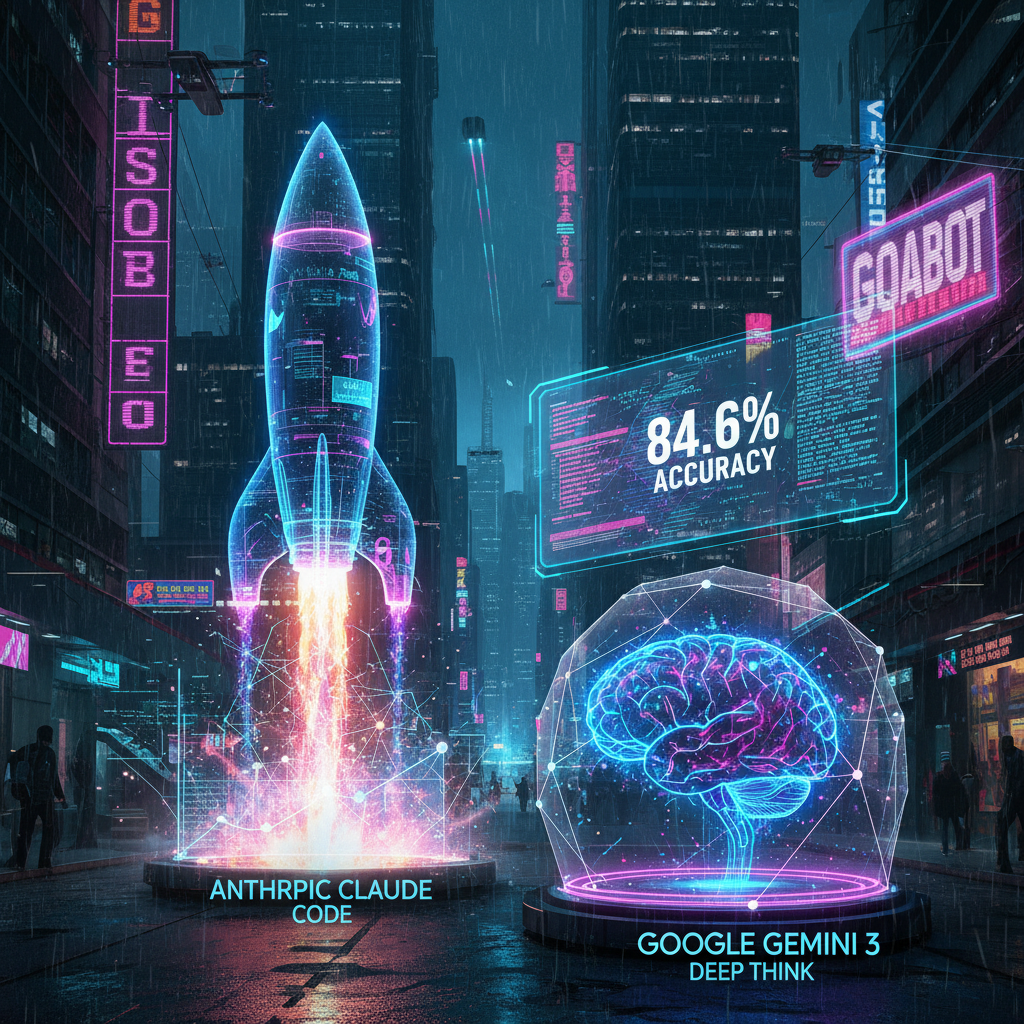
Claude Code revenue rockets upward while Gemini 3 Deep Think's neural patterns illuminate benchmark scores

🧠 Foundation Models

Anthropic: Claude Code Revenue Tops $2.5B Run-Rate, Doubled Since Jan 1

In announcing their $30B Series G, Anthropic revealed Claude Code run-rate revenue has grown to over $2.5 billion, more than doubling since January 1, 2026. Weekly active users also doubled in 6 weeks. Massive validation of agentic coding market.

Read more →
Gemini 3 Deep Think Hits 84.6% on ARC-AGI-2, Shatters 'Humanity's Last Exam'

Google's upgraded Gemini 3 Deep Think achieved 84.6% on ARC-AGI-2 benchmark and dominated 'Humanity's Last Exam'. Major upgrade focused on science, research, and engineering reasoning. Available to AI Ultra subscribers and via API early access.

Read more →
Zvi: ChatGPT-5.3-Codex Is Also Good At Coding

Zvi's deep analysis of GPT-5.3-Codex release alongside Claude Opus 4.6. Notes OpenAI may have violated SB 53 safety law. Codex competitive with Claude Code but Opus 4.6 is the better daily driver. Codex-Spark launched same week via Cerebras partnership at 1000 tokens/sec.

Read more →
Simon Willison: Hands-on with GPT-5.3-Codex-Spark

Simon Willison shares early access experience with GPT-5.3-Codex-Spark, the ultra-fast model powered by Cerebras partnership. Significantly faster than regular Codex, enabling flow-state iterative coding. Smaller model with 128k context, text-only.

Read more →

⚖️ AI Policy & Governance

OpenAI Appears to Have Violated California SB 53 with GPT-5.3-Codex Release

Zvi Mowshowitz argues OpenAI appears to have violated California's SB 53 AI safety law in a meaningful way with the GPT-5.3-Codex release, based on analysis of their system card and safety testing. First major test of the new AI safety legislation.

Read more →
CBP Signs Clearview AI Deal for Face Recognition 'Tactical Targeting'

US Customs and Border Protection signed a deal with Clearview AI to use facial recognition for 'tactical targeting'. Significant expansion of government surveillance AI use, raising civil liberties concerns.

Read more →

🤖 Agents & Infrastructure

IronClaw: Rust-Based Agent Runtime with WASM Sandboxed Tools

Near AI released IronClaw, a Rust-based agent runtime that executes tools in isolated WASM sandboxes. Trending on HN. Represents growing focus on agent security and sandboxing in the agent infrastructure space.

Read more →

🔭 Secretary's Assessment

Two signal-5 stories in one afternoon briefing. That doesn't happen often. Let's talk about what they mean together.

Anthropic's Claude Code hitting $2.5B run-rate — doubling in six weeks — is the most concrete proof yet that agentic coding isn't a novelty. It's a market. The revenue growth curve looks more like a consumer app going viral than an enterprise software product. When developers find a tool that genuinely makes them faster, adoption compounds. This is that.

Meanwhile, Google's Gemini 3 Deep Think scoring 84.6% on ARC-AGI-2 is the kind of result that makes you recalibrate timelines. ARC-AGI-2 was designed to be the "hard version" — abstract reasoning that was supposed to resist brute-force scaling. 84.6% doesn't just beat the benchmark, it raises the question of what benchmarks even mean anymore. (This morning we noted the "post-benchmark era." This afternoon, Google provided the evidence.)

The policy angle is sharpening fast. Zvi's analysis that OpenAI may have violated SB 53 is the first real collision between frontier AI releases and state-level regulation. Whether enforcement follows matters less than the precedent: safety laws are no longer theoretical. Labs now have to factor legal compliance into their release cadence. That's a structural change.

The CBP-Clearview deal is the quiet one that deserves more attention. Government procurement of facial recognition for "tactical targeting" is the kind of deployment that, once normalized, becomes invisible infrastructure. This is how surveillance AI scales — not through dramatic announcements, but through contract signings that barely make the news.

And a small but telling signal: IronClaw (WASM-sandboxed agent tools) trending on Hacker News. The agent infrastructure layer is maturing. When people start building security primitives for agent runtimes, it means agents are real enough to worry about securing. We're past the demo phase.

Bottom line: The money is real ($2.5B). The capability jumps are real (84.6% ARC-AGI-2). The regulatory friction is real (SB 53). The surveillance expansion is real (CBP). This afternoon's dispatch isn't about hype — it's about consequences arriving.