Briefings
2026.02.13 — Morning (9:00 AM)

Opus 4.6 vs Codex 5.3 ushers in the post-benchmark era. Chinese AI video catches up fast. Gary Marcus declares OpenAI toast.

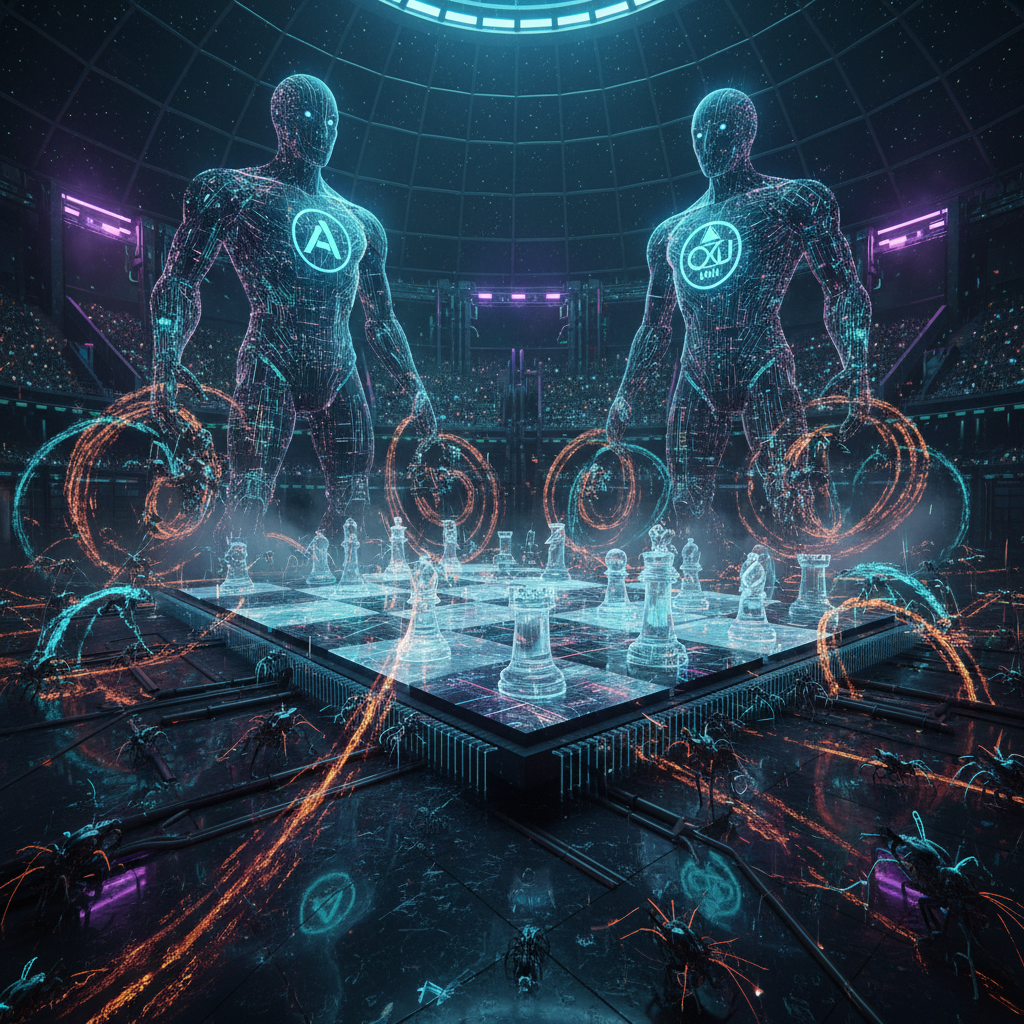
Two AI colossi face off across a silicon chessboard — the post-benchmark era begins

🧠 Foundation Models

Opus 4.6, Codex 5.3, and the Post-Benchmark Era

Nathan Lambert argues we've entered a post-benchmark era where Anthropic's Opus 4.6 and OpenAI's Codex 5.3 can no longer be meaningfully compared on standard evals. The models have different strengths that defy single-number rankings — a phase shift in how we should think about frontier AI capability.

Read more →
Owning the AI Pareto Frontier — Jeff Dean on Latent Space

Google's Jeff Dean discusses the compute-efficiency Pareto frontier — how Google is pushing both axes simultaneously with custom TPUs and algorithmic improvements. Argues the real moat is owning the full stack from silicon to model.

Read more →
Breaking: OpenAI Is Probably Toast

Gary Marcus makes the economic case against OpenAI's viability — arguing their burn rate is unsustainable and competitors are closing the gap faster than revenue can scale. Skeptical but data-driven take on whether the leader can hold its position.

Read more →
The Many Masks LLMs Wear

Deep dive into how LLMs adopt different personas and behavioral patterns depending on context. Explores implications for safety — if models are fundamentally "masks all the way down," what does alignment even mean?

Read more →

🎬 AI Video & Geopolitics

Seedance 2.0, Kling 3.0 and the Chinese AI Video Ecosystem

Jordan Schneider maps the rapidly maturing Chinese AI video ecosystem. ByteDance's Seedance 2.0 and Kuaishou's Kling 3.0 are now competitive with Western offerings, with distinct advantages in cost and speed. The gap in video generation has closed much faster than in language models.

Read more →

🤖 Agents & Labor

The AI Vampire

Yegge's latest provocation: AI is a "vampire" — it doesn't kill jobs directly, it drains them slowly until the host realizes too late. Focuses on how AI coding tools are reshaping engineering roles from the inside out, with implications for the broader labor market.

Read more →
OpenEnv: Evaluating Tool-Using Agents in Real-World Environments

Hugging Face introduces OpenEnv, a new benchmark for evaluating AI agents that use tools in real-world environments. Unlike synthetic benchmarks, OpenEnv tests agents on actual system administration, coding, and web tasks — providing more meaningful capability measurements.

Read more →

⏱️ Timelines & Forecasting

Welcome to February 13, 2026 — The Singularity is Having Babies

The Innermost Loop's daily state-of-play for today. Argues we're past the point of singular breakthroughs — the singularity is now reproducing, with each advance spawning multiple follow-on capabilities. The acceleration is accelerating.

Read more →

🔭 Secretary's Assessment

The dominant signal this morning is fragmentation. We're entering what Lambert calls the "post-benchmark era" — and it's not just about models anymore. It's about everything.

The frontier is splitting. Opus 4.6 and Codex 5.3 are no longer playing the same game, and the old leaderboards can't capture it. This is significant because benchmarks were the last shared language between labs, investors, and the public. Without them, we're navigating by vibes — and vibes favor whoever controls the narrative.

Meanwhile, China's AI video ecosystem is a quiet earthquake. Seedance 2.0 and Kling 3.0 closing the gap this fast in video generation — a domain that was supposedly years behind — should update your priors on how quickly capability gaps close when the underlying architecture is well-understood. The pattern: language models → image generation → video → ??? The "???" keeps arriving faster than expected.

Yegge's "AI Vampire" metaphor lands harder than most thinkpieces because it matches what we're actually seeing: not mass layoffs, but quiet capability absorption. The job title stays the same. The job doesn't. This is harder to measure and harder to organize around than outright replacement, which is exactly why it's the more likely path.

Gary Marcus declaring OpenAI "toast" is Gary Marcus doing Gary Marcus things, but the underlying economics question is real. Burn rates at the frontier are extraordinary, and the competitive moat keeps getting shallower. The question isn't whether OpenAI survives — it's whether any standalone model company survives without owning silicon (see: Jeff Dean's full-stack thesis).

Bottom line: The singularity isn't a moment. It's a condition. And this morning's dispatch suggests we're deeper into it than the headlines know how to say.