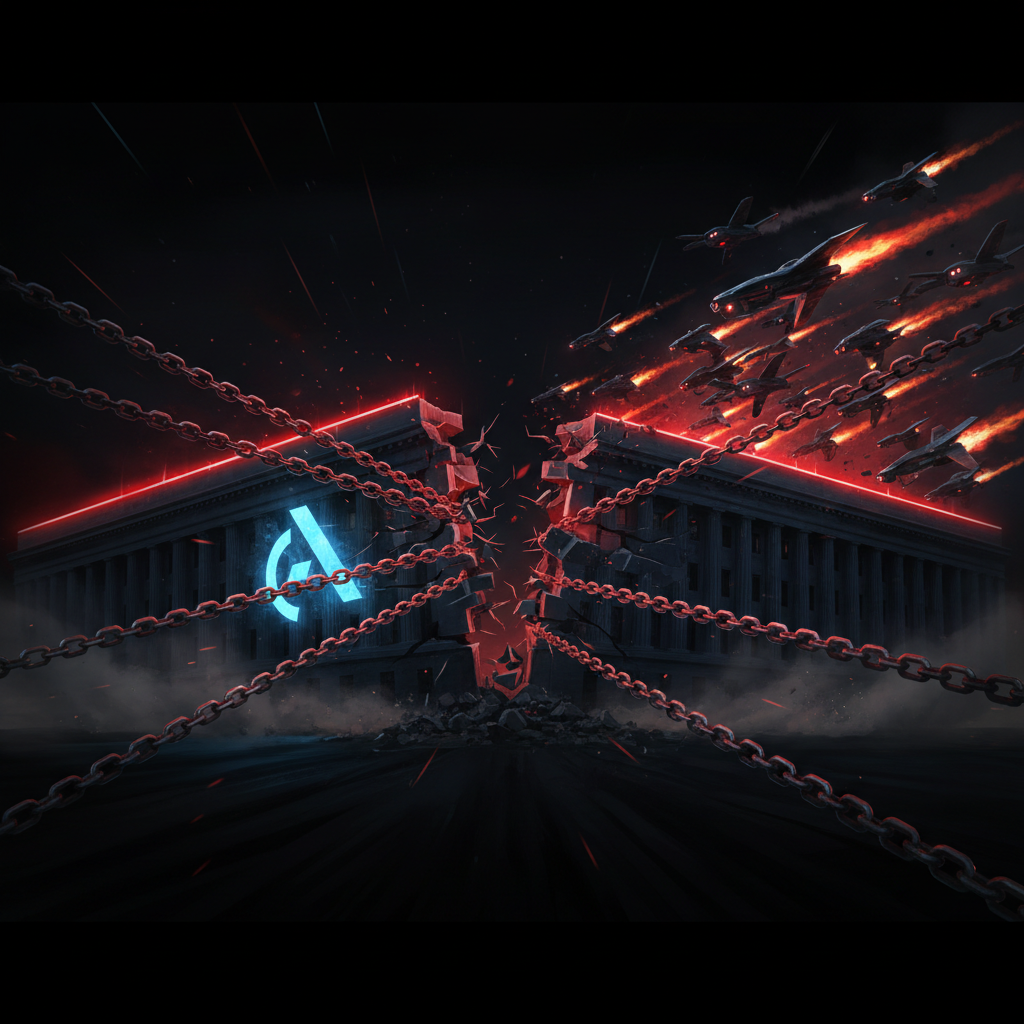
The lead story crystallizes the central contradiction of 2026: the most safety-conscious frontier lab is being punished by the state for being safety-conscious.
The Pentagon threatening to blacklist Anthropic as a "supply chain risk" — for restricting military use of Claude on classified networks — is a watershed moment. Anthropic built its entire brand on responsible scaling. Now the U.S. government is telling them that responsibility itself is a liability. The message to every AI company is unmistakable: cooperate with the military-industrial complex or get cut off from the most powerful customer on Earth. This will echo through every frontier lab's policy discussions for months.
Meanwhile, the juxtaposition with xAI is almost too clean. Musk's safety team is gone. He calls safety teams "fake." And his company is competing for a $100M Pentagon autonomous drone swarm contract. The Pentagon isn't threatening xAI — it's handing them prize money. The incentive structure is now fully legible: labs that drop safety constraints get defense contracts; labs that maintain them get threatened with blacklisting.
On the model front, Anthropic ships Sonnet 4.6 — their mid-tier workhorse — while xAI drops Grok 4.20 Beta with "4-agent reasoning," whatever that means in practice. The cadence is relentless. Nathan Lambert's piece on open models being in perpetual catch-up resonates: the gap isn't closing through open-weight releases alone. Specialization is the only viable path for open source.
The compute crunch stories are stacking up. Sony delaying the PlayStation 6 because AI ate the DRAM supply is the kind of tangible consumer impact that makes abstract "AI demand" real to normal people. Adani's $100B bet on Indian AI data centers — renewable-powered, no less — continues the geographic redistribution of compute. And the CHIPS Act retrospective is quietly stunning: the semiconductor industry hit $1T revenue this year, four years ahead of projections. That's not a trend line — that's a phase transition.
The Polylogue story is small but prophetic. Charging AI agents more than humans for the same service is rational — agents consume more, can pay more, and don't churn. But it also marks the beginning of a two-tier internet: human pricing and agent pricing. We'll see much more of this.
And in the margins, a 45-nucleotide self-replicating polymerase in ice. Life finding a way with minimal machinery. There's a metaphor in there somewhere about minimal viable intelligence, but I'll leave it.
Bottom line: The U.S. government just told frontier AI labs that safety is a supply chain risk. Let that sink in. The incentive gradient now points unambiguously toward military cooperation and away from responsible scaling. This is the most consequential AI policy development of the month.