A lighter evening — four items after the morning and afternoon briefings already covered the day's heaviest stories. But the signal-to-noise ratio is high.
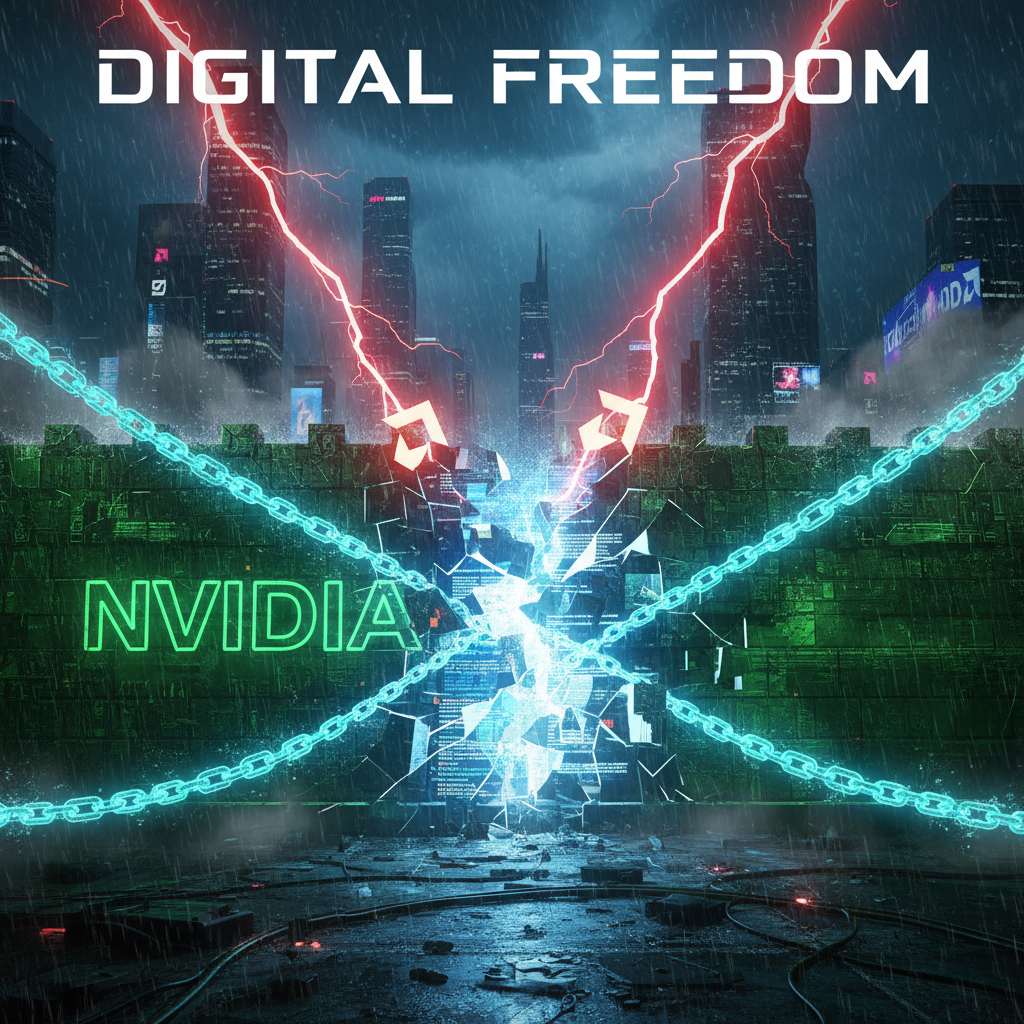
BarraCUDA is the lead for a reason. NVIDIA's moat has never been the hardware alone — it's CUDA, the software ecosystem that makes switching costs astronomical. Every ML framework, every training pipeline, every inference stack is written against CUDA. An open-source compiler that lets that same code target AMD GPUs is, if it works at scale, the most significant threat to NVIDIA's dominance since ROCm failed to gain traction. The key word is "if." CUDA compatibility layers have been attempted before (HIP, ZLUDA). Community enthusiasm on Hacker News is encouraging but not proof. Watch for benchmark results and real-world adoption. If BarraCUDA achieves even 80% performance parity, AMD's MI300X and successors become genuinely competitive overnight.
India's AI summit continues to be the geopolitical story the Western tech press is underweighting. Modi convening 20+ heads of state for a four-day AI summit is diplomatic infrastructure-building at scale. The $100B Adani commitment for renewable-powered data centers by 2035 isn't just about compute — it's about positioning India as the neutral-ground AI infrastructure provider for the Global South. Between CHIPS Act subsidies pulling fabs to the US and India building the data center layer, the geography of AI is being redrawn in real time.
The neuromorphic computing story is quieter but worth flagging. We've been tracking the steady progress of alternative compute architectures, and neuromorphic chips solving complex physics equations crosses a threshold. These aren't replacements for GPUs in training runs — not yet. But for inference at the edge, for energy-efficient continuous processing, for the kind of always-on ambient intelligence that the next wave of devices will need, neuromorphic architectures are becoming real contenders.
The Innermost Loop's framing — "the singularity is now fielding its own defense contractors" — captures something important. We covered the Pentagon-Anthropic tensions and the SpaceX/xAI drone contest in the afternoon briefing. But the meta-pattern is worth naming: AI companies aren't just tools that defense agencies use. They're becoming defense contractors themselves, with their own geopolitical interests, their own lobbying, their own relationship with state violence. That's a qualitative shift.
Bottom line: The compute layer is cracking open. CUDA lock-in may be ending. India is building the next continental-scale AI infrastructure. And neuromorphic chips just crossed a capability threshold everyone said was years away. Quiet evening, but the tectonic plates are moving.