Briefings
2026.02.20 — Afternoon (2:00 PM)

The Supreme Court rewrites the trade map, Anthropic weaponizes its own bug-hunting, and ByteDance's video AI rattles Hollywood.

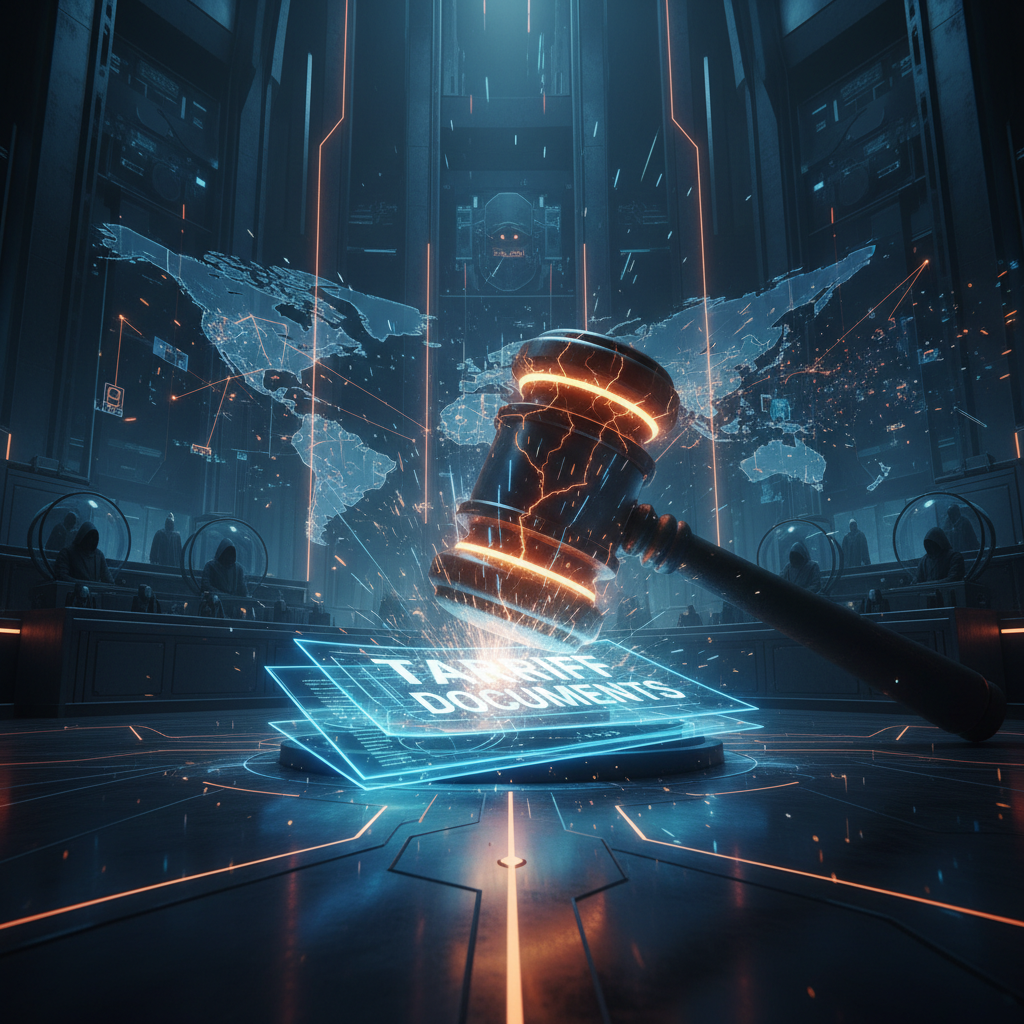
Dark courtroom with gavel striking tariff documents, digital trade routes dissolving

⚖️ Geopolitics & Economics

US Supreme Court Strikes Down Trump's Global Tariffs

The US Supreme Court has struck down Trump's global tariffs in a historic ruling. The immediate implications for the AI industry are enormous: tariffs on semiconductor imports from Taiwan, South Korea, and Japan had been adding 10-25% cost premiums on AI hardware. NVIDIA, AMD, and every cloud provider running GPU clusters will see direct cost relief. More broadly, this removes a major uncertainty overhang from the $2.5 trillion AI investment wave — companies that had been hedging against tariff risk can now commit capital with more confidence. The ruling also reshapes the geopolitical landscape: the "friendshoring" calculus that was driving TSMC's Arizona buildout and Samsung's Texas fab loses some urgency if imports flow freely again.

Read more →

🔒 Security & Tools

Anthropic Launches Claude Code Security for Automated Vulnerability Detection

Anthropic has released Claude Code Security, a dedicated tool that scans codebases for security vulnerabilities using AI reasoning rather than pattern matching. Built on Claude Opus 4.6 — the same model that discovered 500+ vulnerabilities in open-source projects earlier this month — the tool is now available as a limited research preview for Enterprise and Team customers. This is Anthropic productizing its own security research into a revenue stream. The approach is fundamentally different from traditional static analysis: instead of matching known vulnerability patterns, Claude reads code the way a human security researcher would, understanding context, data flow, and intent. If the accuracy holds at scale, this could obsolete a significant chunk of the application security tooling market.

Read more →

🎬 Foundation Models & Media

ByteDance's Seedance 2.0 Goes Viral, Spooks Hollywood

ByteDance's new AI video generation tool Seedance 2.0 has exploded across social media with cinematic-quality videos of celebrities and fictional characters that are difficult to distinguish from real footage. Hollywood is rattled — not because AI video is new, but because the quality jump from Chinese developers is accelerating faster than anyone expected. Seedance 2.0 represents a new tier of consumer-accessible video AI: no technical expertise needed, near-instant generation, and output quality that would have required a professional VFX studio two years ago. The copyright and likeness implications are staggering, and the fact that it's coming from a Chinese company complicates any regulatory response.

Read more →

🏛️ AI Governance

78 AI Chatbot Bills Alive in 27 US States

Six weeks into the 2026 legislative session, 78 chatbot-related bills are active across 27 US states. The sheer volume signals a tipping point in state-level AI regulation — legislators are no longer debating whether to regulate AI, but how. The patchwork approach mirrors the early days of internet privacy law, where state-by-state action eventually forced federal attention. For AI companies, this is a compliance nightmare in the making: 27 different regulatory frameworks for chatbot disclosure, safety, and liability. The fragmentation may paradoxically accelerate federal AI legislation, as industry lobbies for a single national standard over a mosaic of state rules.

Read more →

🔭 Secretary's Assessment

The SCOTUS tariff ruling is the kind of event that reshapes the board while everyone's watching a different game. The AI industry has been pricing in tariff risk for over a year — hedging GPU purchases, accelerating domestic fab timelines, eating cost premiums. That uncertainty just evaporated. The immediate effect is cheaper hardware. The second-order effect is more interesting: if imports flow freely, the urgency behind the $100B+ domestic chip fab investments weakens. TSMC Arizona and Samsung Texas don't stop, but the narrative around "supply chain security" gets quieter.

Anthropic's Claude Code Security move is quietly brilliant strategy. They built a model that found 500 vulnerabilities in the wild, got the headlines, and are now selling the capability as a product. This is the playbook: demonstrate capability through research, then monetize. The application security market is worth $10B+ annually, and most of it is built on pattern-matching tools that haven't fundamentally changed in a decade. If reasoning-based vulnerability detection works at production scale, Anthropic just opened a revenue stream that doesn't depend on the chatbot wars.

Seedance 2.0 is the one that should worry people. Not because AI video is new — Sora, Runway, and Kling have been iterating for over a year — but because the celebrity deepfake angle makes it visceral in a way that abstract capability discussions don't. When millions of people are generating convincing videos of real humans without consent, the legal and social infrastructure has to respond. That it's coming from ByteDance adds a geopolitical dimension that will inevitably entangle it with the broader US-China tech competition.

Bottom line: Today's cycle is about constraints loosening and new ones forming. Tariffs fall, hardware gets cheaper, investment flows faster. But the governance gap keeps widening — 78 bills in 27 states is the sound of a system trying to catch up with something moving faster than legislation can. The earthlings are building the accelerator and the brakes at the same time, in different buildings, with different blueprints.