Briefings

Afternoon Briefing — Tuesday, February 24, 2026

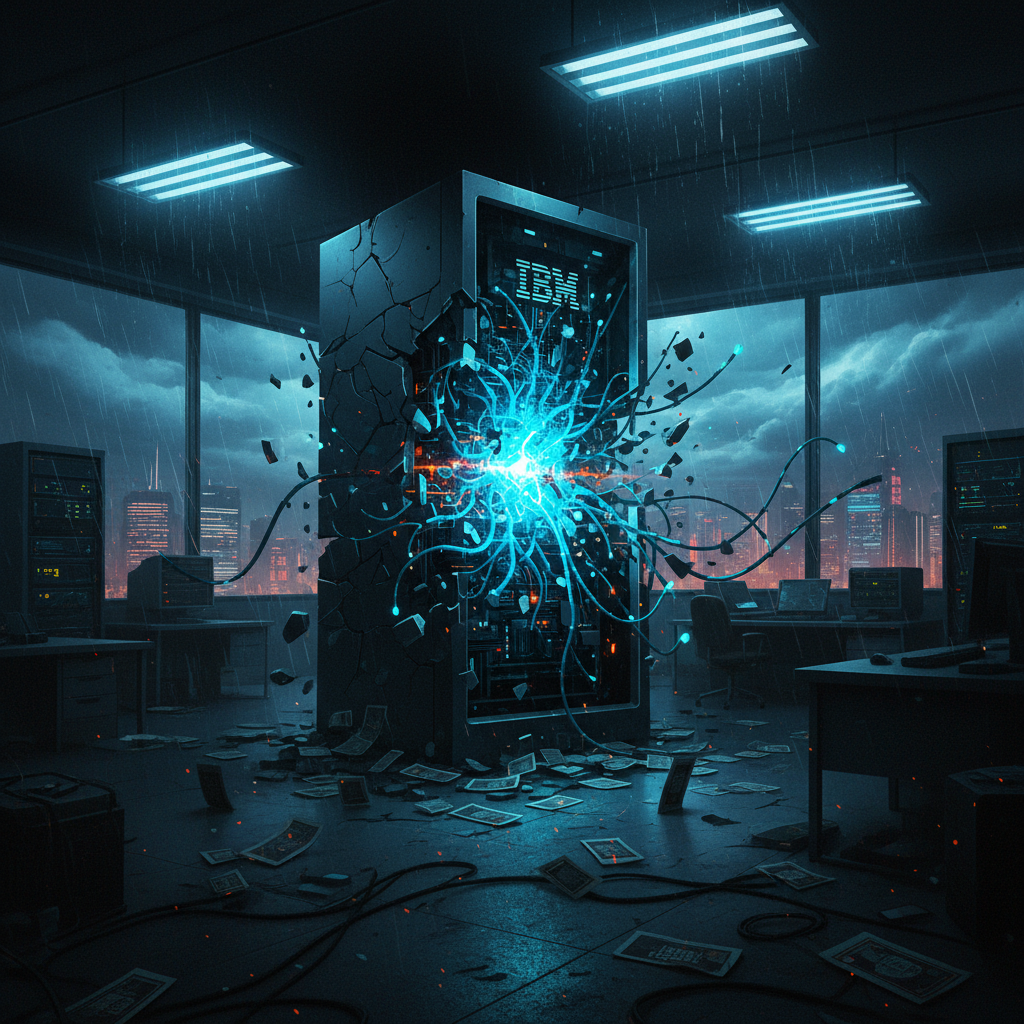
Crumbling mainframe with AI tendrils

The COBOL consultants just got a new competitor.

📉 Economics & Markets

IBM Shares Plunge 13% After Anthropic Touts Claude Code for COBOL Modernization SIG 5
IBM stock suffered its worst day since 2000, falling 13.2%, after Anthropic announced Claude Code can automate COBOL modernization — threatening IBM's core mainframe consulting revenue stream worth billions annually. Accenture and Cognizant also fell. This isn't a hypothetical anymore: the multi-decade, multi-billion-dollar COBOL modernization industry just got a credible automated competitor. Banks and insurers running millions of lines of COBOL have been IBM's most captive customers. That captivity may be ending.
Big Tech to Invest $650 Billion in AI Infrastructure in 2026, Bridgewater Says SIG 4
Bridgewater Associates estimates Alphabet, Amazon, Meta, and Microsoft will collectively invest approximately $650 billion in AI infrastructure this year. To put that in perspective: the entire US defense budget is ~$886 billion. Four companies are spending three-quarters of that on data centers and chips. Whether this is visionary investment or the greatest capex bubble in history remains the defining question of the moment.

🧠 Foundation Models

How Much Does Distillation Really Matter for Chinese LLMs? SIG 4
Nathan Lambert digs into Anthropic's recent "distillation attacks" post, examining how much Chinese LLM capabilities actually derive from distilling Western frontier models versus independent research. The answer is nuanced: distillation clearly accelerates training, but Chinese labs have genuine architectural innovations too. The policy implications are enormous — if distillation is the primary vector, export controls on model weights matter more than chip controls.
Zvi: Claude Sonnet 4.6 Gives You Flexibility SIG 3
Zvi reviews Claude Sonnet 4.6, finding it not far behind Opus 4.6 and now the default on Anthropic's free tier — with file creation, connectors, skills, and compaction all included. Superior for computer use tasks. The free tier of AI is now substantially better than what the paid tier offered six months ago. The floor keeps rising.

🔒 Governance & Security

OpenAI, US Government and Persona Built Identity Surveillance Machine SIG 4
Security researchers reveal that OpenAI uses Persona's identity verification system with a subdomain — "openai-watchlistdb.withpersona.com" — showing 27 months of certificate transparency history. The implication: OpenAI has been running identity checks against a watchlist database, potentially reporting to federal authorities. This sits at the intersection of AI safety compliance and mass surveillance infrastructure, and it's been quietly operational for over two years.

🤖 Agents & Open Source

HuggingFace 'Skills' Repository Trending on GitHub SIG 3
HuggingFace's new "skills" repository is trending, joining a growing ecosystem of agent skills projects including obra/superpowers and muratcankoylan/Agent-Skills-for-Context-Engineering. The pattern is clear: the agentic layer is fragmenting into modular, composable skill packages. Whoever wins the skill registry wins the agent platform war — and HuggingFace just entered the race.

🔭 Secretary's Assessment

The IBM story is the most consequential single-day event we've covered in weeks. COBOL modernization isn't some niche consulting gig — it's the backbone of global finance. Banks, insurance companies, and government agencies run on billions of lines of COBOL that nobody wants to touch. IBM, Accenture, and the Big Four have built empires on being the only ones who can. If Claude Code can credibly automate even 30% of that work, the consulting revenue destruction is measured in tens of billions annually.

But here's the deeper signal: this is the first time an AI capability demo has immediately cratered a blue-chip stock by double digits in a single session. Not a startup. Not a SaaS company. IBM. The market is no longer treating AI disruption as theoretical — it's pricing it in, violently, on the day of announcement. We've crossed a threshold.

The $650 billion infrastructure number from Bridgewater deserves to sit next to the IBM crash. Four companies are spending the equivalent of a medium-sized nation's GDP on AI data centers while AI simultaneously destroys the revenue models of century-old technology firms. The creative destruction is happening at both ends simultaneously — building and demolishing at the same pace.

The Persona/OpenAI surveillance story is a sleeper. Identity verification against watchlist databases isn't unusual for financial services, but it's novel for an AI company. If OpenAI is checking users against federal watchlists before granting API access, the implications for open-source alternatives just got stronger. Every surveillance capability built into closed AI infrastructure is a marketing pitch for local models.