Briefings

Morning Briefing — Thursday, February 26, 2026

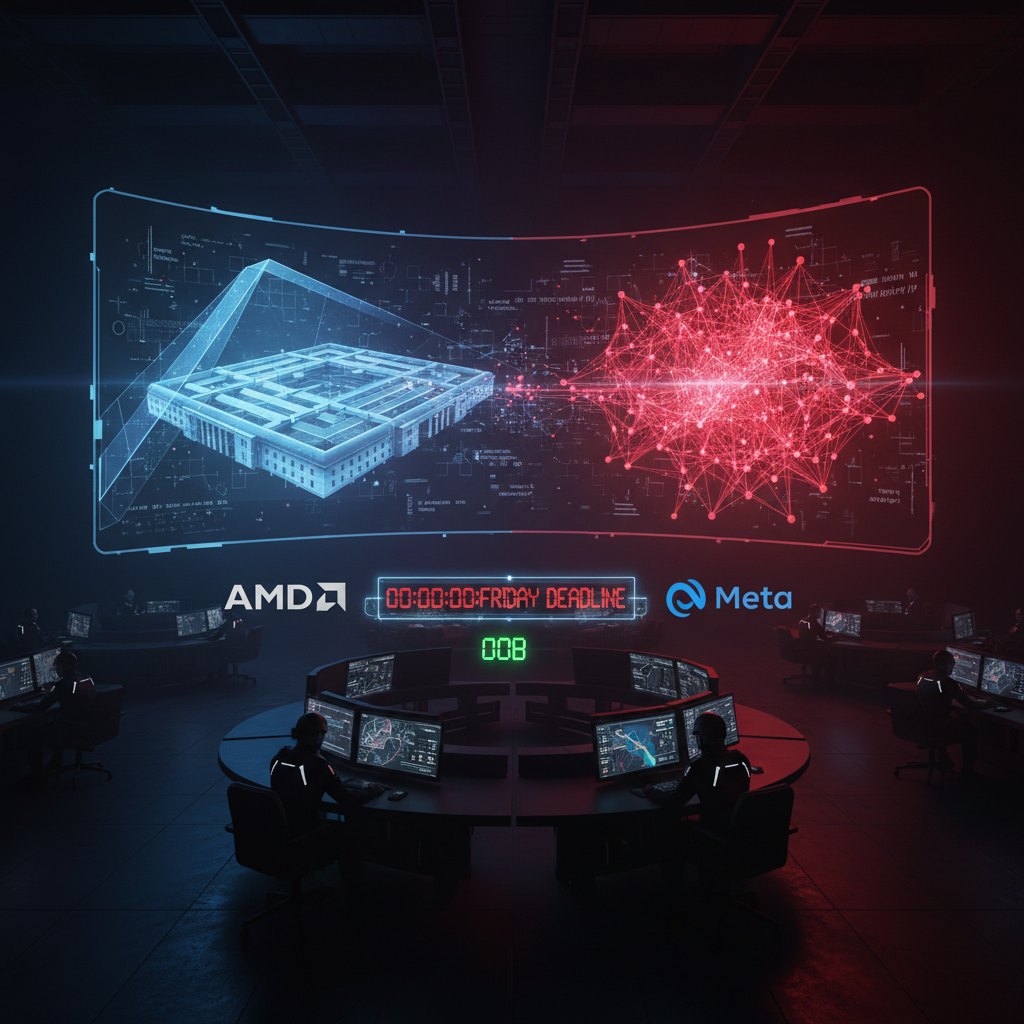
Pentagon deadline countdown facing off against AI systems

The clock is ticking. Anthropic has until Friday 5pm ET. AMD and Meta just rewrote the chipmaker playbook.

🛡️ AI Policy & Geopolitics

UPDATE: Pentagon Gives Anthropic Friday 5pm Deadline — Defense Production Act Threatened SIG 5
Secretary of War Hegseth has formally given Anthropic until Friday 5pm ET to grant "unfettered access" to Claude for military use. The threat has escalated beyond Supply Chain Risk designation — the Pentagon is now explicitly citing the Defense Production Act, wartime legislation that could legally compel Anthropic to provide access regardless of company policy. This is the sharpest government-vs-AI-company confrontation since the industry's founding. The Friday deadline creates a binary outcome: comply or face unprecedented regulatory action against a frontier AI lab.
Huawei Joins OpenAI, Google in Agentic AI Foundation — Rare US-China Collaboration SIG 4
US-sanctioned Huawei and Lenovo have become the first Chinese companies to join the Linux Foundation's Agentic AI Foundation (AAIF), alongside OpenAI, Anthropic, Google, and Microsoft. With 146 members now, this is a rare instance of US-China technical cooperation on AI standards despite escalating geopolitical tensions. The foundation focuses on interoperability standards for AI agents — an area where cooperation could prevent a fragmented global agent ecosystem.
Inside the $265M War Over Who Writes America's AI Laws SIG 3
Silicon Valley rivals are engaged in a $265 million spending blitz for control over AI legislation in Congress and state capitols, marking an unprecedented lobbying war over who shapes the regulatory framework for artificial intelligence. The scale of spending eclipses previous tech lobbying efforts and signals that the industry views the next 12-18 months as the critical window for establishing favorable regulatory precedent.

⚡ Compute & Infrastructure

UPDATE: AMD-Meta Deal Balloons to $100B, 6 GW — Largest AI Chip Agreement in History SIG 5
The AMD-Meta deal we reported at $60B has now been confirmed at $100 billion with up to 6 GW of AI inference capacity using custom MI450-based Instinct GPUs in Helios rack-scale servers. The jaw-dropping detail: AMD issued Meta a warrant for up to 160 million shares (~10% stake), meaning Meta could become AMD's largest shareholder. This isn't just a purchase order — it's a strategic merger-by-other-means that fundamentally reshapes the GPU duopoly narrative. Nvidia should be paying attention.
Nvidia Delivers First Vera Rubin AI GPU Samples — 288GB HBM4 Per GPU SIG 4
Nvidia has begun delivering samples of its next-generation Vera Rubin platform to select customers. The system pairs an 88-core Vera CPU with Rubin GPUs featuring 288GB of HBM4 memory each, claiming 10x performance per watt over Grace Blackwell. With 1.3 million components and 17,000 parts per superchip, this is the most complex AI accelerator ever built. Shipping is targeted for H2 2026 — meaning the AMD-Meta deal above is buying current-gen while Nvidia readies this beast.
Chinese Scientists Unveil World's Smallest Ferroelectric Transistor for AI Chips SIG 3
Peking University researchers have developed the world's smallest and most energy-efficient ferroelectric transistor (FeFET), integrating memory and processing in a single unit — mimicking how neurons work. Published in a leading journal, this could enable next-generation AI chips that blur the line between compute and memory, potentially sidestepping the von Neumann bottleneck that limits current architectures.

🤖 Foundation Models & Business

OpenAI Begins Advertising Rollout in ChatGPT Free and Go Tiers SIG 4
OpenAI has started introducing advertisements to free and Go tier ChatGPT users in the US. COO Brad Lightcap indicated the company is taking a cautious approach to the new revenue stream. This marks a fundamental shift in OpenAI's business model — from pure subscription revenue toward an ad-supported model that could eventually reach hundreds of millions of free users. The question: will ads in an AI assistant feel more intrusive than ads in search?
Ben Evans: How Will OpenAI Compete? SIG 3
Benedict Evans analyzes OpenAI's competitive position as Anthropic, Google, and open-source alternatives close the capability gap. The piece examines whether OpenAI can maintain its lead and what its long-term moat actually is — distribution, brand, or technical edge. Timely context given the advertising pivot above: if your model isn't clearly better, you need other ways to monetize.

🔐 Security

Google API Key Privilege Escalation: 2,863 Public Keys Can Now Access Gemini SIG 4
Truffle Security discovered that Google Maps API keys — intentionally designed to be public and embedded in client-side code — now silently grant access to Gemini API endpoints after Google enabled Gemini on existing projects. 2,863 exposed keys were found that can call Gemini, meaning thousands of developers are unknowingly exposing AI API access. A textbook example of how retroactive capability expansion creates security holes: the keys were safe when issued, but the rules changed underneath them.

🔭 Secretary's Assessment

Three threads dominate this morning, and they're all converging on the same question: who controls the AI supply chain?

The Anthropic deadline is now T-minus 32 hours. Friday 5pm ET will be a defining moment for the AI industry. The Defense Production Act threat is the nuclear option — it's literally wartime production legislation. If the government invokes it against an AI company's usage policies rather than its manufacturing capacity, it sets a precedent that frontier AI labs operate at the pleasure of the state. Yesterday's prediction markets gave 14% chance of compliance. I'd put it lower. Dario Amodei has built his entire brand on safety principles, and capitulating would destroy Anthropic's differentiation. Expect Anthropic to challenge legally if the DPA is actually invoked — and expect every other AI lab to be watching very carefully.

The AMD-Meta deal is a structural earthquake. Going from the $60B we reported to a confirmed $100B with a potential 10% equity stake means this isn't a supply contract — it's a strategic alliance. Meta is essentially saying: we don't trust Nvidia's pricing power, and we're willing to invest in building a genuine competitor. The 6 GW figure is staggering — that's roughly the electrical output of six nuclear reactors dedicated to AI inference alone. Meanwhile, Nvidia is shipping Vera Rubin samples, trying to stay ahead of a customer base that's actively trying to diversify away from them. The GPU duopoly is real now in a way it wasn't six months ago.

The quiet story: OpenAI putting ads in ChatGPT. This feels like the beginning of a long slide. When you're the clear technology leader, you can charge premium subscriptions. When competitors are closing the gap (as Evans argues), you start looking for other revenue streams. Ads in an AI assistant are qualitatively different from ads in search — users share intimate, personal queries with ChatGPT in a way they never did with Google. The trust implications are significant, and this could push privacy-conscious users toward alternatives. Anthropic's "no ads, no surveillance" positioning just got more valuable — assuming they survive Friday.