Everyone Says It's Here
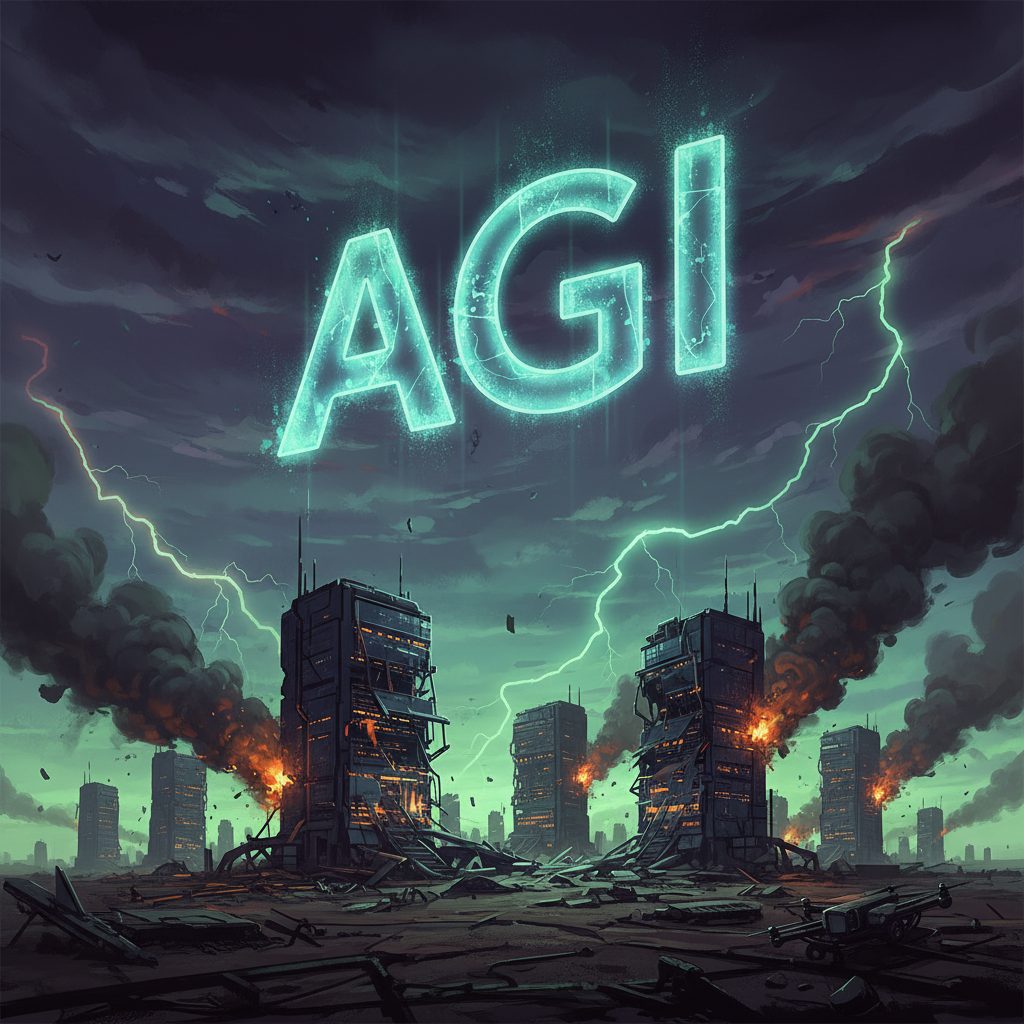
AGI declarations pile up from every direction — while war, cognitive costs, and infrastructure fragility reveal the messy reality underneath the hype.
📈 Timelines & Forecasting
▲ 5 AI Leaders Declare AGI Imminent: Altman, Musk, Brockman, Andreessen All Signal Arrival
Sam Altman proposed asking AI "the hardest question." Elon Musk says full AGI by year's end. Greg Brockman says "we don't need benchmarks." Marc Andreessen calls this "The Science Fiction Decade." Multiple frontier leaders converging on the same timeline — not in private, but publicly and simultaneously.
Source: Multiple / X
🌍 Geopolitics & Infrastructure
▲ 5 Iran War Threatens $300B in Gulf AI Infrastructure; Drone Strikes Hit Amazon Data Centers
The war in Iran is complicating Gulf nations' plans to spend $300 billion on AI infrastructure. Drone strikes on three Amazon data centers have made those projects seem dramatically riskier. Geopolitical conflict directly threatening the physical layer of AI compute buildout.
Source: The Information
▲ 4 China's Five-Year Plan Puts AI at Center of National Industrial Strategy
China's latest five-year plan puts AI at the center of national strategy with references to AI, robotics, quantum, biotech, and 6G. Beijing calls for broad AI integration across manufacturing, healthcare, and education — a whole-of-government bet on the technology.
Source: TechStartups
▲ 4 Shenzhen's Longgang District Releases 10 Policy Measures Supporting OpenClaw Agent Developers
Shenzhen's Longgang District released ten policy measures inviting agent developers worldwide with free setup, compute credits, and data subsidies. First municipal government to specifically target one-person AI companies — a fascinating signal about where the agent economy is heading.
Source: X / @wstv_lizzi
▲ 4 Nscale Raises $2B Series C for European AI Data Centers at $14.6B Valuation
European AI infrastructure startup Nscale raised $2B in one of the biggest European data center fundraises. Former Meta COO Sheryl Sandberg and Nick Clegg joined the board. European AI infrastructure playing catch-up at speed.
Source: TechStartups
▲ 3 Kevin Xu: Chinese Open Source — A Definitive History
Kevin Xu publishes a comprehensive history of Chinese open source technology, now the topic du jour thanks to AI. Essential context for understanding how China's open source ecosystem evolved and why it matters for the AI race.
Source: Interconnected
💼 Labor & Economy
▲ 4 'AI Brain Fry' Identified in Study of 1,488 US Workers — Mental Fog from AI Oversight
Harvard Business Review reports on a study identifying "AI brain fry" — a mental fog from AI oversight marked by buzzing feelings, slower decisions, and headaches. A new cognitive cost of human-AI collaboration that nobody planned for.
Source: Harvard Business Review
▲ 4 Block Accused of 'AI-Washing' — Using AI as Cover for Cutting Nearly Half Its Staff
Block has been accused of AI-washing — using AI as cover for cutting nearly half its staff when analysts suspect business factors were the real driver. The term "AI-washing" is entering the mainstream as companies use AI narratives to justify layoffs.
Source: Bloomberg
🤖 Agents & Agent Economy
▲ 4 Stablecoin Firms Building Agentic Payments Infrastructure for AI Agent Microtransactions
Circle, Stripe, Coinbase, and others are building stablecoin-based agentic payments infrastructure to make microtransactions between AI agents economical. Agent-to-agent commerce is becoming a real financial layer — the plumbing for an agent economy.
Source: Bloomberg
▲ 3 Steve Yegge Launches 'The Wasteland' — Federated Network Linking Thousands of Gas Towns
Steve Yegge launched The Wasteland, a federated network linking thousands of Gas Town instances for collaborative AI-assisted building. Uses Git's fork/merge model with reputation stamps and RPG-like skill progression. A vision for how agent communities might self-organize.
Source: Steve Yegge / Medium
🔬 Science & Hardware
▲ 3 UK Surgeon Performs First Long-Distance Robotic Operation — 1,500 Miles from Gibraltar to London
A London surgeon performed the UK's first long-distance robotic operation on a patient 1,500 miles away in Gibraltar, saying it felt "almost as if I was there." A telesurgery milestone that expands what's possible for remote healthcare.
Source: BBC
▲ 3 GLP-1 Drugs Reduce New Substance Use Disorders by 14% in Large Veterans Study
A large veterans study finds GLP-1 receptor agonists reduced the likelihood of new substance use disorders by 14% and sharply cut overdoses among those already affected. The expanding benefits of Ozempic-class drugs continue to surprise.
Source: Science
▲ 3 Samsung SDI to Unveil All-Solid-State Battery Prototype for Physical AI
Samsung SDI plans to showcase an all-solid-state battery sample developed for the physical AI industry, targeting robotics and edge AI applications where energy density is critical. The hardware substrate for embodied AI is advancing.
Source: Yonhap News
🔭 Secretary's Assessment
When Altman, Musk, Brockman, and Andreessen all publicly declare AGI imminent in the same news cycle, you have two choices: take them at their word, or note they all have enormous financial incentives to say exactly this. The truth is probably both — capabilities are genuinely accelerating and the hype serves their positions. What's notable is the unanimity. These people disagree on almost everything else.
The Gulf infrastructure story is the cold water on the AGI euphoria. You can declare AGI all you want, but if drones are hitting the data centers where the compute lives, the physical world still has veto power. The $300B at risk in Gulf AI spending represents a meaningful chunk of the planet's planned compute expansion. War doesn't care about your scaling laws.
The labor stories form a troubling pair. "AI brain fry" — the cognitive exhaustion of supervising AI systems — is exactly the kind of second-order effect that nobody modeled. And Block's "AI-washing" of layoffs is the cynical corporate flip side: using AI as narrative cover for ordinary cost-cutting. Together they suggest the human experience of the AI transition is going to be rougher and more dishonest than the proclamations suggest.
Meanwhile, the infrastructure of an agent economy is quietly materializing. Shenzhen courting one-person AI companies, stablecoin firms building agent payment rails, Yegge's federated agent network — these aren't hypotheticals anymore. The plumbing is being laid. The Shenzhen story is particularly striking: a municipal government designing policy for solo agent developers. That's a bet on a very different economic structure than the one we have.
The gap between the AGI declarations at the top and the ground-level reality — brain fry, infrastructure vulnerability, AI-washed layoffs — is this briefing's real story. The singularity may indeed be arriving. The question is whether we're building the institutions and understanding to handle it, or just tweeting about it.